
SERVICES · RETIREMENT ROADMAP
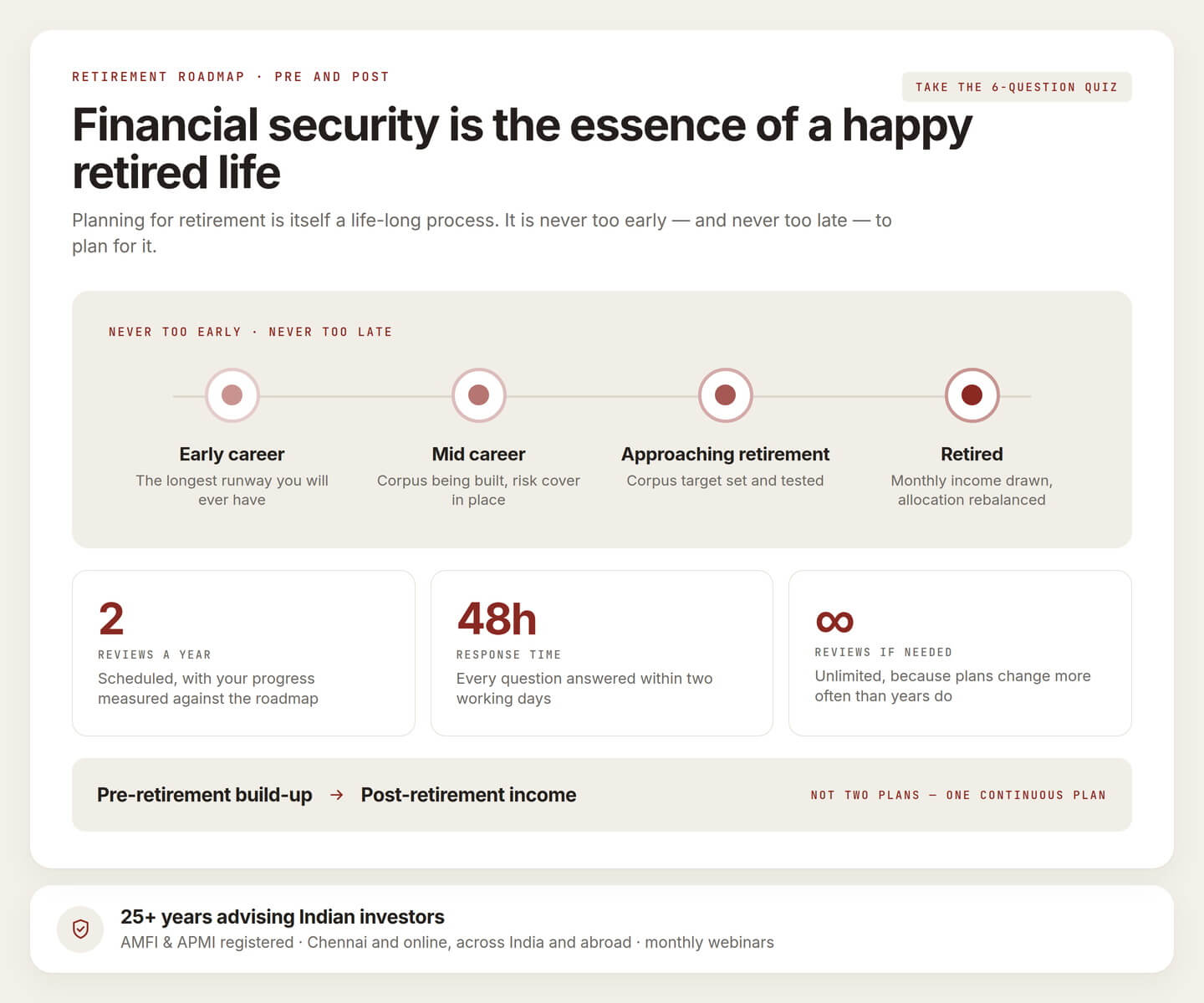
Financial security is the essence of a happy retired life
Planning for retirement is itself a life-long process. When the first salary arrives we focus on career and family — and in between the two, retirement gets ignored because we think it is too early.
“It is never too early or too late to plan for retirement.”
-
Pre and post-retirement planning
-
Two scheduled reviews a year
-
Response within 48 hours
THE DEFINITION
What is retirement planning?
Retirement planning is planning your finances to achieve your financial goals after you stop working — the final part of your financial life. It lets you live your desired lifestyle when you retire, and achieve financial independence.
The process includes analyzing your financial goals and objectives, your age, risk appetite, inflation, estimated expenses and life span.
Because your retirement planning should ensure a stress-free retired life, it is better to entrust this onerous task to a professional — a Financial Planner for Retirement.
Holistic retirement planning: why it matters
Holistic retirement planning considers not just investments but risk management, insurance, health, tax planning and lifestyle goals — so the retirement is genuinely secure.
Investments
Risk management
Insurance
Health
Tax planning
Lifestyle goals
WHY YOU NEED IT
Unplanned situations you have to be ready for
Your life expectancy turns out longer than you had planned
Unexpected medical expenses and other emergencies
Unexpected medical expenses and other emergencies
You end up depending on your children after retirement
Your savings cannot beat inflation
You still have duties to fulfil for your family after retirement
WHY IT IS IMPORTANT
Just imagine — are you prepared?
Sudden health issues that require constant care and force you to retire early
You lose your job to an unexpected situation, as thousands did during the corona crisis
Someone in your family needs your support and you give up your job to care for them
An accident affects your ability to carry out regular duties and forces you to retire
Occupational burnout becomes a serious threat and forces you to retire
A holistic retirement plan prepares you for all of it — what lies ahead post-retirement, what to do pre-retirement, and how to live free from any financial stress.
THE QUIZ
Think you don’t need retirement planning? Take this quiz
If you can answer all six, you really don’t need to plan your retirement. If you are unclear on at least three, it is the right time to start.
01
How much money do you need per month, or per year, when you retire?
02
What kind of investment strategy do you need to achieve that retirement income?
03
Do you know how to deal with your loans during retirement?
04
Do you know how to analyze your existing portfolio after retirement, and the most effective way to do it?
05
Health becomes a major issue in old age — do you have a clear idea of the right medical insurance scheme after retirement?
06
Do you have an effective tax planning strategy after retirement?
WHAT YOU GET
Eleven parts of a personalized retirement plan
Retirement planning gives you the solution to every problem above. This is what the service covers.
Identifying your financial and retirement goals
Current portfolio analysis
Analysis of your current financial situation
A well-planned investment strategy
Risk analysis
Fresh asset allocation planning
Tax planning
Emergency fund planning
Existing asset mix analysis
Planning for the retirement corpus
Cash-flow planning for the post-retirement stage
RETIREMENT WEALTH
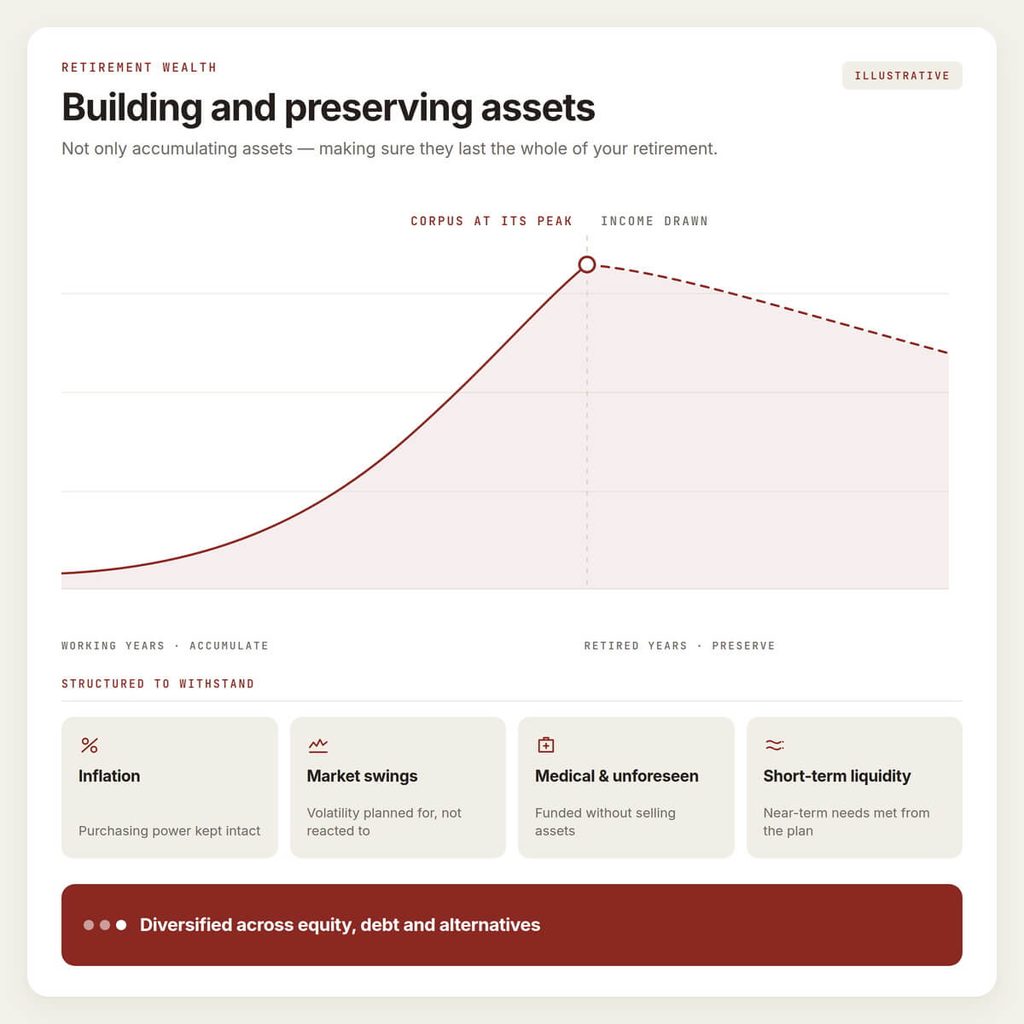
Building and preserving assets
Retirement wealth is not only about accumulating assets, but about making sure those assets last throughout your retirement — a careful combination of investment planning, risk management and regular portfolio reviews.
Simply saving money is not enough. Your wealth should be structured to combat inflation, market fluctuations and unforeseen expenses like medical emergencies, growing steadily while staying liquid enough to meet short-term needs.
Diversifying across equity, debt and alternative investments strengthens the portfolio against volatility and preserves long-term wealth.
WHAT MAKES IT SPECIAL
Beyond the standard process, we help you build
Well-structured pre-retirement and post-retirement financial planning
A risk management plan covering emergency as well as insurance planning
Income, expense, asset planning and liabilities aligned under one report
Achievable scenarios, created until you are satisfied with one
Concentrated effort on reducing tax
Scheduled discussions with our CFPs and advisors for every query
A step-by-step guide file with stipulated time for all executions
Two scheduled reviews in a year
ADDITIONAL BENEFITS
Support while you execute
We assist you in implementing the plan, handholding you through documentation and preparing asset performance reports.
Any number of reviews, if the situation demands
Accessible and responsive within 48 hours
Periodic reviewing and rebalancing of investment allocation
Newsletters circulated periodically
Scheduled progress-review discussions with the Chief Financial Planner every year
An exclusive webinar with financial experts every month
A personalised retirement roadmap to visualise and track your progress
Guidance on retirement wealth allocation to maximize corpus and minimize risk
HOW IT HELPS
Our service builds the retirement corpus you actually need
Achieve your financial independence
Achieve your financial and retirement goals
Plan your tax efficiency after retirement
Increase your savings rate
Plan for inflation
Live your desired retirement life
Keep your post-retirement lifestyle sustainable without compromising comfort
Strategically align your portfolio to long-term retirement objectives
MAGICAL THINKING
Top 5 reasons people fall into the trap of not planning
People consciously believe retirement planning is necessary — but some inner thoughts lead them into an unplanned retirement.
REASON 01
“My children will take care of me after retirement”
Times are changing — people prefer nuclear families now, and your children carry their own responsibilities: their kids’ education, healthcare, their own retirement planning.
Relying solely on children may limit your independence and financial flexibility in retirement.
REASON 02
“I’ll inherit enough money”
Relying on inheritance is risky for three reasons:
The market value of inherited property may depreciate over time
Additional liability of repair and maintenance
Property that must be distributed can lead to unending disputes at the court level
REASON 03
“I’ll save once I have enough”
It is never going to be enough. Saving requires discipline and a real lifestyle adjustment — and a small saving now has a bigger impact than a large one years later.
Early, consistent savings amplify the snowball effect and the power of compounding works like magic.
REASON 04
“I think it’s too late now”
It is never too late. You may realize the importance close to retirement age, or already be retired — but not planning the upcoming years is still an expensive deal in the long run.
Even late starters can optimise existing assets, restructure investments and extend retirement income efficiently.
REASON 05
“My children will take care of me after retirement”
Retirement seems far away in your early years, and there is a common notion that you don’t need to plan until you are almost there. But time slips fast. An unplanned life is easy to pass by; a planned one takes effort, and that effort always pays off.
A small sum invested periodically can turn into crores through compounding. People who start saving in their early 20s reap the highest benefits — the sooner you start, the better your chance of living your dream retirement.
TAKE THE FIRST STEP
Take the first step toward your next wealth milestone
Start with a no-cost Wealth Check and see the roadmap from where you are today to ₹1 Cr, ₹5 Cr and beyond.
PHONE
+91-44-4203 0722
ramalingam@holisticinvestment.in
rajan@holisticinvestment.in
OFFICE
Old No 60/3, New No 26, Burkit Road,
T. Nagar, Chennai – 600017, India